

The meme that is making the rounds…
Perhaps you’ve seen it.
Jesus and Buddha are drinking tea together and talking in Heaven like old friends, at the “celestial tea house”.
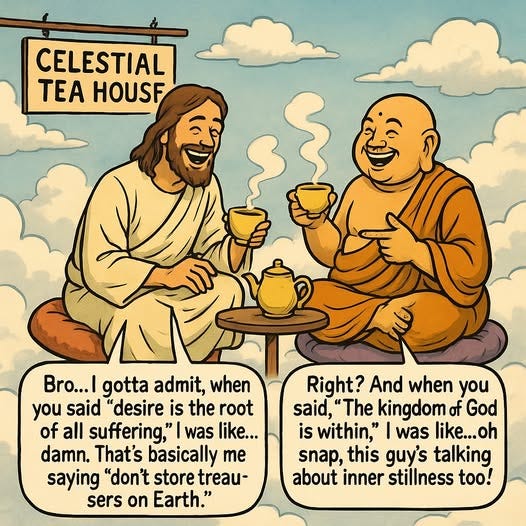
Jesus says, “When you said desire is the root of suffering, I was like ‘that’s basically me saying don’t store up treasure on earth.’”
Buddha replies, “Right? When you said the Kingdom of God is within, I was like, ‘Oh snap, that’s inner stillness too.’”
Underneath it, a caption ties a bow on the whole thing:
“Different robes. Same truth.
Let go of desire. Find the kingdom within.
Detach from the external. Anchor in the eternal.
Call it God, call it Awareness, call it Love…
All paths, same mountain. Walk yours with heart.”
It’s poetic.
It’s popular.
And it’s completely in opposition to biblical Christianity.
Let’s Be Honest: It Feels Like Love… But It’s a Lie
I get the appeal.
We’re exhausted from division. We crave unity.
And who wouldn’t want Jesus and Buddha sipping tea together in celestial harmony?
But when you flatten their teachings into the same bucket of “universal truth,” you lose what made either of them distinct.
You don’t get harmony.
You get distortion.
And the moment you bend truth, you turn it into a lie.
This is exactly what Satan did with Eve, and tried to do with Jesus.
Jesus and Buddha: Not the Same Mountain
Let’s stop pretending they were preaching from the same mountaintop.
Buddha taught that suffering comes from desire. The answer? Detach. Empty yourself. Erase the ego. Dissolve into Nirvana.
Jesus taught that suffering comes from sin.
The answer? Repent. Believe.
Follow Him into life eternal with a personal God.
Jesus doesn’t tell you to extinguish the self.
He tells you to crucify the old self, and be reborn as a new creation.
That’s not semantics.
That’s salvation.
"Whoever wants to be my disciple must deny themselves and take up their cross daily and follow me.” — Luke 9:23
The Gospel Is Not a Koan
In Zen, a Koan is a riddle.
A paradox meant to collapse logic, disrupt identity, and break down the self until realization dawns.
It’s elusive on purpose. You’re supposed to wrestle with it endlessly.
Enlightenment comes only when you stop trying to “figure it out.”
But the Gospel is not like that.
The Gospel is not cryptic. It’s clear.
It’s not hidden in mystery for the few who can crack the code.
It’s revealed in plain speech for all who would believe:
“For I delivered to you as of first importance what I also received: that Christ died for our sins in accordance with the Scriptures,
that He was buried, that He was raised on the third day…” — 1 Corinthians 15:3–4
The Gospel isn’t meant to be deciphered like a riddle.
It’s meant to be received like a lifeline.
And here's the danger: When people spend years decoding spiritual riddles, they often mistake obscurity for depth.
Mystery starts to feel like maturity.
Ambiguity gets dressed up as enlightenment.
And eventually, clarity itself starts to feel beneath them. Too obvious, too simple, too childlike.
But Jesus didn’t come for the spiritually elite. He rebuked spiritual elitists, and instead turned to the broken, the childlike, and the desperate.
He didn’t hide the truth in riddles for those clever enough to ascend a spiritual mountain.
He brought truth down to earth, and put it on a Cross.
“I thank You, Father… that You have hidden these things from the wise and learned, and revealed them to little children.” — Matthew 11:25
The Gospel isn't an intellectual trophy or a mystical secret.
It’s the power of God unto salvation.
Not for the proud, but for the one who bows.
Jesus vs. Buddha: What They Actually Taught
They weren’t teaching different languages of the same truth.
They were pointing in entirely different directions.
Buddha said:
“Desire is the root of suffering.”
“Extinguish the self.”
“Dissolve into Nirvana.”
“Awaken by your own realization.”
Jesus said:
“Sin is the root of suffering.”
“Deny yourself, take up your cross, and follow Me.”
“Be born again by the Spirit.”
“I am the Resurrection and the Life.”
These are not parallel teachings.
They are fundamentally incompatible conclusions.
In other words, they weren’t whispering the same truth in different accents.
They were giving opposite diagnoses, and offering opposite cures.
“The Kingdom of God Is Within You”? Not Like That
Luke 17:21 is a favorite in these spiritual mashups:
“The kingdom of God is within you.”
Sounds mystical, right?
But context matters.
Jesus was talking to the Pharisees, not handing out meditation tips. The Greek phrase can also mean “among you” or “in your midst.”
He wasn’t pointing them inward.
He was pointing to Himself.
“The Kingdom is here, because the King is standing right in front of you.”
Not a metaphor. A reality.
Desire Isn’t the Problem. Disordered Desire Is.
Buddhism sees desire as the root of suffering, and extinguishing it as the path to peace.
But Jesus doesn’t condemn desire, He redeems it.
Jesus never said, “Detach from desire.” Rather, He said:
“Where your treasure is, there your heart will be also.” (Matt. 6:21)
“Seek first the Kingdom.” (Matt. 6:33)
He didn’t condemn longing.
He redirected it toward the eternal, not the temporal.
Jesus doesn’t kill desire. He restores it to its proper object: the Father.
The problem isn’t wanting.
It’s what you want most.
“Blessed are those who hunger and thirst for righteousness, for they shall be satisfied.” — Matthew 5:6
“Delight yourself in the Lord, and He will give you the desires of your heart.” — Psalm 37:4
The goal of Buddhism is to escape the self.
The goal of Jesus is to save you, not erase you. Not save the ego, but the eternal soul that lives in all of us.
No, Not All Paths Lead to the Same God
The meme says, “Call it God. Call it Awareness. Call it Love.”
But Jesus didn’t give you that option.
“I am the Way, the Truth, and the Life. No one comes to the Father except through Me.” — John 14:6
That’s not the language of “multiple paths.”
That’s a closed door with one Key.
It might offend our modern sensibilities.
But truth doesn’t bend to preference.
What Sounds Inclusive Often Becomes Deceptive
We like the idea that we’re all climbing the same mountain.
But if the summit isn’t the same… then the path matters.
And if Christ is who He says He is, then reducing Him to a wise guru isn’t respect.
It’s rejection wearing a smile.
“Sanctify them in the truth; Your word is truth.” — John 17:17
Zen thrives on spiritual haze, where questions matter more than answers, and silence becomes salvation.
And while stillness has value, the Gospel is not a riddle to sit with.
It is a message to receive: Christ died for sinners, was buried, rose again, and will return.
This is not a parable. It's a proclamation.
Many who carry spiritual wounds (especially from legalistic or harsh religion) seek refuge in mysticism that softens all sharp edges.
They redefine “truth” as whatever brings them internal calm. And that calm becomes the test of spiritual validity.
But emotional peace is not the same as saving grace.
Spirituality that cannot bear clarity is often not healing, it’s hiding.
What begins as a search for healing can become a form of spiritual elitism, where only those who’ve “done the work,” suffered enough, or sat in enough silence are considered enlightened enough to understand.
That’s not Christianity.
That’s mysticism dressed in Gnostic robes, where salvation is for the spiritually elite, and the Cross is optional.
The Gospel doesn’t require secret knowledge or endless meditation.
It invites you to come and die, to crucify the old self and rise in Him.
Yes, trauma is real.
Yes, religion can wound.
But healing isn’t found in self-erasure or abstract union with the universe.
It’s found in the person of Jesus, who was pierced so we could be made whole.
He is not a concept.
He is a King.
And He doesn't invite you to decode a riddle.
He commands you to follow.
Jesus leads to the Cross.
Buddha leads into a cave with no light.
One calls you to die so you can live.
The other invites you to disappear so you no longer feel.
There Is No Resurrection Without a Cross
Jesus didn’t offer transcendence.
He offered His blood.
Not enlightenment, but atonement.
You don’t awaken to your divinity.
You bow before His.
I want to be clear: this isn’t a condemnation of people, but rejection of what is ultimately an empty philosophy.
Many who turn to Buddhism are trying to make sense of real pain.
Often, they’re not rejecting Jesus, they’re rejecting a version of Him that was cold, cruel, or corrupted by religion.
My heart breaks for that.
But the answer isn’t detachment, it’s redemption.
Not dissolution, but resurrection.
Not a mystical fog, but the blazing clarity of Christ crucified and risen.
Final Word (and It’s Not Mine)
This isn’t about being combative.
It’s about clarity.
You can appreciate elements of other traditions.
You can show respect to people of all beliefs.
But you don’t have to pretend all roads lead to the same destination to be loving.
True love doesn’t blur lines to keep everyone comfortable. It tells the truth, even when it costs.
Jesus didn’t come to affirm every path.
“For the time is coming when people will not endure sound teaching, but having itching ears they will accumulate for themselves teachers to suit their own passions… and will wander off into myths.” — 2 Timothy 4:3–4
Buddhism, for all its stillness and silence, is still a myth.
A myth that offers no blood, no atonement, no resurrection.
It offers release from suffering, but not redemption from sin.
Jesus came to blaze the path that leads home.
“Everyone who hears these words of mine and puts them into practice is like a wise man who built his house on the rock.” — Matthew 7:24
Don’t build your life on a meme. Don’t build your faith in a myth.
Build it on the Rock. Crucified, risen, and returning.
Author’s Note:
Some will read my conviction as unkindness.
Others may be unnerved by my certainty, mistaking it for arrogance.
But nothing could be further from the truth.
What you’re hearing is a burning passion.
A zeal for truth, forged in the fire of my own trauma, and my redemption through Christ.
Jesus never bent truth to make it easier.
He spoke it plainly, then wrapped it in grace.
Not to lower the standard, but to invite us to come to terms with it…
and by His mercy, come to love it.
Yes! RE-directed desire. RE-directed longing, energy, purpose. This is the power of the resurrection.
"...they often mistake obscurity for depth. "
💯